No, traditional SEO isn’t dead, but the version where you rank first and collect the click is shrinking fast, and the data shows exactly how much. Here are the numbers that matter most. When a Google AI Overview appears, Ahrefs found the top-ranking page’s click-through rate was 58% lower than expected, based on December 2025 data. SparkToro’s 2026 study found that 68% of US Google searches ended without a click from January to April. And a study of more than 16,000 websites found Google organic clicks fell 15% in a year.
But the same data holds a counterweight. Google still sends far more traffic than any AI assistant, and the pages AI tools cite are often the ones SEO already helped rank. At Ranko Services, we help brands handle both sides, so this guide separates the hype from the evidence and shows what to do next.
Key takeaways
- SEO isn’t dead, but clicks per search are falling. Position 1 earns far less than it did before AI Overviews.
- Zero-click is now the majority outcome: 68% of US Google searches in early 2026, per SparkToro.
- Google still dwarfs AI in referral traffic. In one study of 16,661 sites, AI assistants sent about 1.25 visits for every 100 from Google organic.
- What’s dying is thin, generic, keyword-first content. What still works is technical health, brand authority, original data and tools.
- The practical answer is both: keep doing SEO, and add AI search optimization (also called GEO or AEO) on top.
Why people keep saying SEO is dead
The claim comes from four real changes, and each one hits a different part of the old playbook.
- AI answers now sit above the links. Google’s AI Overviews, which it launched in 2024, give people a written summary before any result. In Pew Research’s March 2025 browsing study, about 18% of Google searches produced one, and longer, question-style searches triggered them far more often than one- or two-word queries.
- Most searches end without a click. SparkToro’s 2026 analysis found that 39% of US searches ended with no further action and another 29% led straight to a new search. Only 32% produced a click.
- Anyone can publish content now. Ahrefs reports that 74% of new web content is created with generative AI. When competitors can publish 50 articles a week, a generic blog post stops being an advantage.
- People search in more places. Ahrefs cites a 2024 Fortune report that 45% of Gen Z searches on TikTok, Instagram and other social platforms rather than on Google alone.
Put together, these changes break one assumption: that ranking well automatically earns you the visit. That assumption is what’s dying. The next section checks how much of SEO itself is going with it.
What the data says: is SEO traffic really collapsing?
Clicks per search are falling sharply, but Google’s reach is holding and AI referral traffic is still small. Four sources show the full picture.
Clicks per search are falling
Pew Research Center tracked 900 US adults and 68,879 Google searches in March 2025. Users clicked a traditional result in 8% of visits when an AI summary appeared, against 15% when it didn’t. Only 1% of visits included a click on a link inside the summary, and 26% of visits with a summary ended the browsing session, compared with 16% without one.
Ahrefs compared 300,000 keywords. For keywords that trigger an AI Overview, the average position 1 click-through rate fell from 7.3% in December 2023 to 1.6% in December 2025. Against a forecast of 3.7% without AI Overviews, that is a 58% reduction. Every position on page one lost clicks, and the loss shrinks as you move down the page.
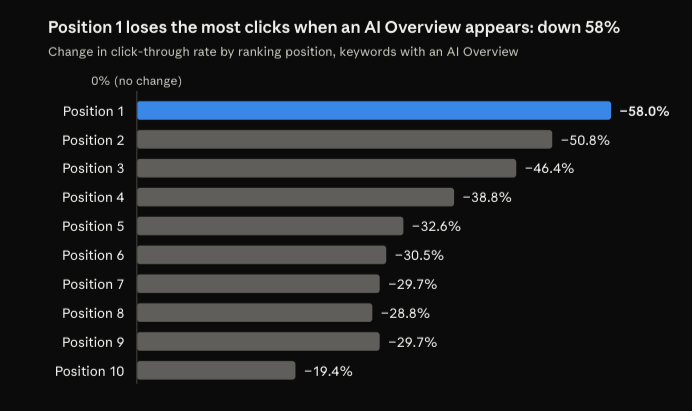
Ahrefs measured desktop click-through rates from aggregated Search Console data, and it describes the result as a correlation, not proof of cause.
Google still dwarfs AI as a traffic source
In the same SEOcrawl data, AI referral traffic grew about 45% year on year, yet AI assistants sent only 1.25 visits for every 100 that Google organic sent. ChatGPT accounted for 83% of AI referrals. The study notes that measured AI traffic is a floor, because app visits without a referrer and clicks from Google’s own AI features are not counted as AI. Ahrefs’ data from 2025 told a similar story: Google held almost 90% of global search share, and across about 82,000 sites it sent 345 times more traffic than ChatGPT, Gemini and Perplexity combined.
AI answers still lean on pages SEO helped rank
Ahrefs reported that 76.1% of pages cited in AI Overviews ranked in the top 10. Other studies find lower overlap, so ranking helps but doesn’t guarantee a citation. We cover the gap in why sites rank on Google but not in AI answers. The overall picture is a channel that pays out less per search but hasn’t disappeared. The question isn’t whether to do SEO. It’s which parts still earn their keep.
What’s dying in SEO and what still works
Cheap, repeatable tactics are fading, while work that is hard to copy still pays off. Here is where each common approach stands, based on the studies above.
| Tactic | Status | What the data says |
| Ranking for broad informational queries and expecting the click | Declining | Ahrefs measured a 58% lower position 1 click-through rate on AI Overview keywords, and SEOcrawl found informational sectors lost the most Google clicks |
| Mass-produced, generic content | Fading | Ahrefs reports 74% of new web content is created with generative AI, so anyone can publish the same pages |
| Judging success by rankings and traffic alone | Outdated | SEOcrawl saw impressions hold flat (up 0.4%) while clicks fell 15%, and SparkToro found 68% of searches end without a click |
| Technical SEO: crawlability, indexing, speed | Still essential | Ahrefs notes AI assistants retrieve pages through search engines, and a study it cites found 9 in 10 pages retrieved by SearchGPT were among Google’s first results |
| Branded, local and high-intent transactional searches | Holding up | Fishkin says SEO still pays off for these, and SEOcrawl found travel and e-commerce sites grew AI referrals fastest (up 120% and 54%) |
| Brand mentions and authority building | Rising in value | Ahrefs found brand web mentions have the strongest correlation (0.664) with appearing in AI Overviews |
| Free tools, original data and deep guides | Resilient | Ahrefs found free-tool keywords didn’t see the same click-through decline, even when an AI Overview appeared |
The pattern is clear. What’s fading is work anyone can produce in an afternoon, and what holds up needs real expertise, real data or a real brand behind it.
How to adapt: a practical plan for SEO and AI search
Keep the fundamentals that still work, protect the searches that still pay, and add AI search optimization on top. Here are seven steps in order.
- Find which of your keywords trigger AI Overviews. Tools such as Ahrefs let you filter your ranking keywords by AI Overview in the Organic keywords report. Those are the pages where position alone won’t earn the click.
- Protect the searches that still pay. Branded, local and high-intent pages keep more of their clicks, so keep their titles and snippets sharp, fix crawling and speed, and make sure structured data matches the page. Technical SEO is the first activity in our SEO 360™ roadmap.
- Rebuild informational pages to be cited and clicked. Open each section with a direct answer, then add what a summary can’t: original data, a free tool, a worked example. Ahrefs found free-tool keywords didn’t see the same click-through decline. Our guide to getting cited by AI shows how.
- Build brand mentions beyond your site. Earn coverage through digital PR, expert comment, guest articles and community answers. Ahrefs found brand web mentions had the strongest correlation with appearing in AI Overviews, and the link-building strategy in SEO 360™ is built to grow that authority.
- Add AI search optimization to your plan. Generative engine optimization (GEO) and answer engine optimization (AEO) are names for the same job: being cited or recommended in AI answers. They build on SEO rather than replace it, because AI assistants retrieve pages through search engines. Track a fixed list of customer questions across ChatGPT, Perplexity and Google every month.
- Change what you measure. Rankings and sessions alone mislead when impressions hold and clicks fall. Add brand searches, conversions, referral sessions from AI assistants and citation tracking. Remember that measured AI traffic is a floor, because some AI-driven visits are logged as direct or organic.
- Show up where people search. Buyers research on YouTube, Reddit and social platforms before they ever reach Google. Ahrefs calls this Search Everywhere Optimization.
If you’d rather hand this over, an AI SEO agency can run the whole system. At Ranko, SEO 360™ combines technical SEO, content, link building and an AI Visibility Score for ChatGPT and Perplexity, and you can see what SEO 360 includes in detail. You can also read more about Ranko.
Frequently asked questions
Is SEO dead in 2026?
No. Clicks per search are falling, but Google still sends far more traffic than AI assistants. In SEOcrawl’s study of 16,661 sites, Google organic sent about 80 times more visits than all AI assistants combined, even though SparkToro found that 68% of US searches ended without a click.
Is traditional SEO still worth it?
Yes, if you aim it at the right searches. Branded, local and high-intent searches still pay off, and Ahrefs notes that AI assistants retrieve pages through search engines, so SEO also feeds AI citations.
Will AI replace Google search?
Not on current data. Ahrefs put Google’s share of global search at almost 90% in 2025, and SEOcrawl found AI assistants sent about 1.25 visits for every 100 from Google organic in 2026. AI referrals did grow around 45% in a year, so plan for both channels.
What is zero-click search?
It is a search that ends without a click to any website. SparkToro’s 2026 analysis found 68% of US Google searches ended that way between January and April.
Do AI Overviews kill organic traffic?
They reduce it without erasing it. Pew found clicks on traditional results fell from 15% to 8% of visits when an AI summary appeared, and Ahrefs measured a 58% lower click-through rate for position 1 on AI Overview keywords.
What is the difference between SEO and GEO?
SEO aims to rank your pages and earn clicks. Generative engine optimization (GEO), also called answer engine optimization (AEO), aims to get your brand cited or recommended inside AI answers. The two share the same foundations of crawlable pages, helpful content and authority.
How much does SEO cost?
At Ranko, Starter SEO starts at $150 per month and SEO 360™ at $550 per month, and the latter includes AI visibility tracking. Compare plans on our pricing page.
Conclusion
SEO isn’t dead, but the old deal of rank first and collect the click has changed. Protect the searches that still pay, rebuild informational content around original data and real expertise, and add AI search optimization so your brand is cited where answers are written. Measure all of it, because rankings alone no longer tell you the whole story.
If you’d like help, start with a free SEO trial to see where your site stands today, or contact our team to plan your next steps with SEO 360™.